Longer-term contracting opportunities in renewable energy portfolios increased amidst volatile market prices – The Lantau Group’s Mike Thomas
He mentioned that for some companies, following the market is safer in ensuring competitiveness rather than risking locking in long-term contracts.
Surging electricity demand from AI data centres, rapid urbanisation, and heavy industry have forced a structural transition toward rapid capacity expansion and decarbonisation across the Asia Pacific. Record deployments of solar, wind, and battery storage, alongside a deliberate resurgence in nuclear energy, are also reshaping national generation mixes. Consequently, recent regional policies concerning energy have targeted long-term security against volatile global fuel markets.
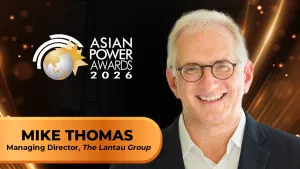
Sharing his valuable insights is The Lantau Group’s Managing Director, Mike Thomas, who has over 30 years of energy consulting experience. He specialises in applying economics and analytics to market, regulatory, and decarbonisation challenges. His experience extends across the wide spectrum of energy market designs and regulatory arrangements.
As one of the judges at the Asian Power Awards 2026, Thomas explores the industry’s evolution, including challenges that energy-intensive sectors are facing with decarbonisation, as well as the market and regulatory reforms needed to support a reliable energy system amidst renewable generation expansion. He also seeks to understand how regulators are responding to emerging technologies and what the future of the sector looks like in the region.
Having spent more than 30 years advising energy sector stakeholders across different markets, what are the most significant changes you have witnessed in the power industry?
More and more market development is done by committee and arguably with less attention to the economic fundamentals. There is risk in Asia of some markets just not advancing materially beyond central management with ad hoc features for some customers or technologies. Less focus on market solutions yet more use of market “words”. There is much greater interest from customers, especially larger ones, in controlling their energy costs – but this is often compromised by limited market transparency, incomplete information, bundled or aggregated factors that really should be separated or distinguished, and not a lot of clarity about the way in which key costs, charges, risks, or processes will evolve. Of course, all of this is happening against an explosion of opportunity for solar and battery storage, which has almost become so obvious it is not worth mentioning any more. The devil is once again in the details. Knowing solar and battery storage are “in the money” does not help you understand Malaysia’s CRESS charges, or address incomplete facets of Vietnam’s DPPA instruments, or analyse grid curtailment more accurately given many Asian markets make detailed grid data highly secretive. So the biggest change now is that all of these things are swirling around at the same time, making it a pretty wild time to be in energy in APAC.
How can energy-intensive industries remain competitive whilst pursuing ambitious decarbonisation goals?
Each industry has a different risk profile with respect to fuel-related commodities. Whereas every company prefers to have lower costs than its competitors, it really doesn’t want to be stuck with higher costs. In some cases, just following the market is safer rather than taking the risk of locking in long-term contracts that may sometimes be higher cost. Keeping that in mind, with volatile gas, oil, and coal prices affecting Asian power markets, the opportunity for longer-term contracting around solar and battery storage or other longer-term fixed-price RE portfolios has increased. The problem is often the non-energy part – the system access, dispatch and curtailment risk, and other tariff aspects whose costs may not be fixed or certain or even understood going out into the future. What we see in markets like Texas in the USA, where end users are shaping their power contracting, vastly exceeds what we are seeing in Asia, and yet the benefit of RE is probably greater in Asia, as gas and coal prices are typically higher than in the USA. It’s confounding at times because it could be going faster and end users could be doing more. So many of our end-user clients express frustration and exasperation at what they (and we) know ought to be possible but isn’t, quite. Each year, we chip away at this, though. Perhaps eventually it will accelerate even more.
Having said that, I don’t think it is really being driven quite as broadly by decarbonisation goals – some companies and sectors are focused there of course, but most are looking for lower-cost power, which also happens to align with the energy transition.
As renewable generation grows, what market reforms are needed to maintain reliability and system resilience?
A lot of the role of markets is to make it possible for stakeholders to form their own views about the future. Markets are supposed to work on supply and demand and not be so influenced by policy shifts, incomplete regulation, market power, unbalanced market structures, limited access, lack of clarity on grid performance, outlook, or dispatch. You have to start with a spot market, but then all the other parts are supposed to be there too. For now, we see gaps in grid-related information, treatment of curtailment risk, system access charge confusion, incomplete tariff reforms, over-reliance on central auctions that are not strictly tied to reliability or adequacy issues, retail reforms that have not happened yet, and absence of things like ancillary services markets and capacity value (whether through an energy-only market or a capacity payment). In the meantime, there are lots of opportunities, nonetheless, but they will tend to require longer-term contracts, which have some potential of rebounding badly on total system costs to customers, as they are rarely "optimal"; they are just “necessary”.
With growing demand and falling technology costs, it is a somewhat forgiving time to make mistakes, so long as enough projects can actually get built, but we’d like to see more attention to the underlying fundamentals and other enabling elements and features. Reforms that could really make a long-term difference for economic growth, decarbonisation, and cost-efficiency/reasonableness.
How are regulatory frameworks adapting to keep pace with emerging technologies in the power sector?
Too slowly. With too little funding. Often there is too much reliance on NGO money, which is lovely but often slow and cumbersome. My first project in one ASEAN country was for a regulator who could not afford to pay for the project and had to source the funds from another market stakeholder who had the ability (with the regulator’s approval) to pass the costs on for collection through tariff surcharges. It’s a little better, but not much. Advanced regulation, market development, pilot programmes, regulatory sandbox arrangements, market monitoring, competition enforcement — these take funding and expertise. Would love to see more of Asia’s regulators get more resources so they can do their jobs at the levels they know they want to.
Looking ahead, how do you see the region’s power sector evolving?
I see the region’s power sector growing significantly. We are on a long-term trajectory of transformation and energisation.
As a returning judge in the Asian Power Awards 2026, how would you define and assess projects that are truly transformative?
Every transformative project, whether it is the first seed or an exemplary blossom, starts with people trying to do something exceptional. When it is successful, the team reflects with pride. It can be a larger scale, a newer application, an unexpected benefit, or an indigenously developed capability. It can be a template for others or just an important milestone along a developmental or organisational advancement pathway. Some entities that seem to go from strength to strength are notable because repetition highlights what is possible for others. Vision matters, but execution against clear challenges is what I look for.







 Read Here
 Advertise
 Sign Up