Roland Berger’s Dieter Billen: Governance failures often the earliest warning sign of a troubled project
He said this comes as investors are scrutinising utility management quality, transparency of tariff setting, and anti-corruption safeguards.
Rising water demand, climate risks, resource constraints, and ageing infrastructure are reshaping how water is managed across Asia Pacific. Greater focus is now being placed on water security and sustainable treatment solutions, and these priorities are now opening opportunities for innovation and investment in water supply, wastewater management, and resilient infrastructure.
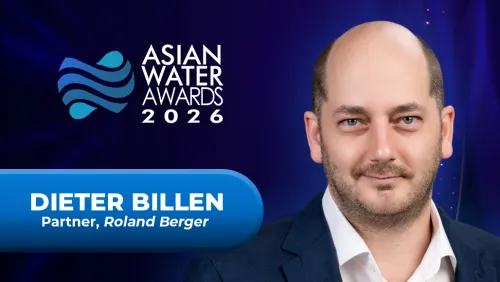
Offering his valuable insights in this discussion is Roland Berger Partner Dieter Billen, who has 15 years of consulting experience and has worked across several Southeast Asian markets. He specialises in infrastructure development, with a particular focus on energy, utilities, and renewable energy. He has advised investors, energy companies, and developers on energy transition initiatives, covering areas such as renewable energy development, energy efficiency, energy services, and market liberalisation.
As one of the judges at the Asian Water Awards 2026, Billen lays out the lessons and challenges involved in delivering infrastructure projects across emerging markets, with a particular focus on Asia’s growing water infrastructure needs. He also examines how governments, investors, and developers can collaborate to address water stress and accelerate sustainable infrastructure investment, whilst also considering how evolving ESG expectations are shaping investment decisions.
Having spent 15 years advising governments, investors, and developers, what are the biggest lessons you've learned about delivering successful infrastructure projects in emerging markets?
If there's one lesson that stands above the rest, it's that bankability is decided long before financial close — it's built into the earliest stages of project structuring. Unsuccessful projects often trace their problems back to weak feasibility work and unclear risk allocation.
To get infrastructure projects approved, feasibility studies often include optimistic demand or financial projections, rather than realistic forecasts. This is because the parties developing these forecasts typically have an incentive to create a rosy picture to seek project approvals.
Unclear or weak risk allocation is the other typical failure. Risks are often disproportionately pushed to parties, making projects unviable, whereas ideally risks should be borne by the party having most control of that particular risk. For example, political, regulatory, permitting, and certain demand risks should ideally (but not always) be borne by the government, whereas construction, operations & maintenance, technology and financing risks should typically be borne by the private investor. When risks are allocated to parties that have limited control over them, they may make projects unbankable.
Hence, objectively and critically assessing demand and financial projections and proper risk allocation early on in the project structuring are critical success factors. Another important element is local capacity building. Projects that bring in strong local partners, train local operators early, and build knowledge on the ground tend to be far more resilient than those run almost entirely by an outside or international team.
As Asia faces increasing water stress due to urbanisation, industrial growth, and climate change, what do you see as the region's biggest water infrastructure challenges over the next decade?
Asia's water challenge is really three converging pressures at once. Rapid urbanisation is straining networks that were often designed for far smaller populations decades ago. Industrial growth is increasing both demand and the risk of contamination, particularly in fast-growing secondary cities that don't have the utility maturity of major capitals. And climate change is making water availability less predictable — more intense droughts in some basins, more extreme flooding in others, and shifting monsoon patterns that utilities and planners weren't designed around.
On top of that sits a structural issue: non-revenue water. Many utilities across the region still lose a significant share of treated water to leakage and unbilled consumption, which means even well-designed new infrastructure is being undermined by ageing or poorly maintained existing networks. The next decade's real challenge is building new capacity, and at the same time modernising and maintaining what already exists whilst financing those investments at a scale governments alone are unlikely to fund.
How can governments and private investors work together to accelerate investments in sustainable water infrastructure across Asia?
The single biggest unlock is well-structured, bankable pipelines rather than one-off projects. Investors want to see a credible pipeline, not just a single asset, because that's what justifies the fixed costs of entering a market. Governments that publish clear project pipelines, standardise contract terms, and commit to consistent tariff and regulatory frameworks attract far more capital than those negotiating each deal from scratch. Countries like Brazil and Saudi Arabia have done so in the last years, attracting significant interest from global investors. South-East Asian countries have a similar opportunity to create a pipeline of investment projects, bringing in more private capital. This typically requires market reforms, for example, in terms of consolidating smaller concessions into larger bankable ones.
Blended finance also has a growing role — using concessional or development finance to absorb early-stage or first-loss risk so private capital can come in at commercial terms. And PPP structures that fairly allocate risk (rather than pushing currency, political, or demand risk entirely onto the private partner) get financed faster and cheaper. Finally, transparent, independent regulators can significantly boost investor confidence.
As ESG expectations continue to evolve, how are they influencing investment decisions in water and utility infrastructure projects?
ESG has moved from a reporting exercise to a genuine underwriting factor. Lenders and equity investors increasingly want to see climate resilience built into project design from the start — not just carbon metrics, but how a water treatment plant or network will perform under future drought or flood scenarios. Social licence has become a real due diligence item too: projects with poor community relations or unresolved land and resettlement issues are seen as higher risk, not just a reputational concern.
On the governance side, investors are scrutinising utility management quality, transparency of tariff setting, and anti-corruption safeguards much more closely than five years ago, because governance failures are usually the earliest warning sign of a troubled project.
Which emerging technologies do you believe have the greatest potential to transform water utilities in Asia?
A few stand out for near-term, practical impact: smart metering and IoT-based leak detection, which directly attack non-revenue water — arguably the highest-return technology investment for many Asian utilities today. AI-driven network modelling and predictive maintenance let utilities move from reactive repairs to anticipating failures before they happen. Advanced treatment technologies, including membrane-based desalination and water reuse, are becoming more cost-competitive and critical in water-stressed cities. Digital twins allow utilities to test infrastructure investments and climate scenarios virtually before committing capital. Decentralised and modular treatment systems can extend service to peri-urban and rapidly growing areas faster than large centralised plants.
The technologies that will matter most aren't necessarily the most novel. They are the ones that help utilities fix what they already have and use existing capital more efficiently. For example, there is a large opportunity to reuse water for digital infrastructure, especially data centres, across the region. Technologies are not the bottleneck – it’s about creating an ecosystem amongst relevant stakeholders to invest in new infrastructure, including pipelines, for water reuse for digital infrastructure and surrounding (industrial) customers. Given the rapid growth of data centres in Southeast Asia, for example, in Malaysia, this presents a significant growth opportunity.
As a judge for the Asian Water Awards 2026, what key attributes define a truly transformative initiative?
As a judge, I look for initiatives that demonstrate genuine systemic impact. The attributes that separate a strong project from a transformative one include measurable, sustained impact — not just a successful pilot, but evidence that the initiative has kept delivering results over time. Scalability and replicability are also important — a solution that other utilities or cities facing similar constraints could realistically adopt. Financial and operational sustainability matter as well — the initiative needs to be able to be viable. Finally, innovation should solve a real constraint, whether that's technological, financial, or institutional — not innovation for its own sake.











 Read Here
 Advertise
 Sign Up