Asia data centres face power squeeze as demand grows
Legrand sees Southeast Asia becoming a larger growth market as operators balance rapid capacity expansion with tighter power, water and land constraints.
Asia’s data centre expansion is accelerating, but the next phase of growth will depend increasingly on how efficiently operators use constrained infrastructure across different markets.
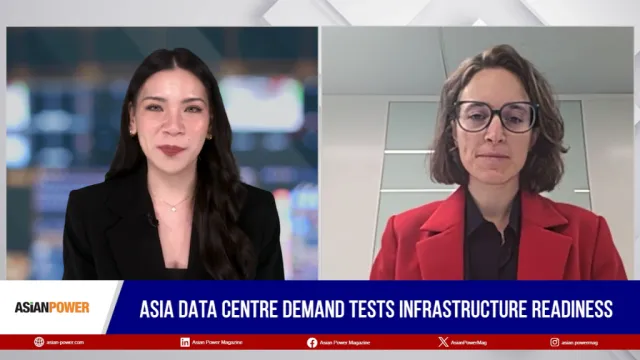
Blandine Antoine, Executive Vice President for Products and Technology at Legrand, said Asia currently contributes 10% to 15% of the group’s global sales, with Southeast Asia amongst its fastest-growing markets. Data centres now account for 32% of Legrand’s total sales.
Malaysia has become a major part of that expansion. Following acquisitions of LinkBusways and SRS Power Engineering, Legrand’s sales footprint there increased from about €20m to nearly €300m.
“The need for more data processing and more data storage is just unavoidable,” Antoine said, pointing to AI inference, connected devices, cloud computing and software-as-a-service as drivers beyond AI training alone.
The challenge is accommodating that demand where power, water and land are limited. Legrand said 40% of the equipment it sells into data centres is aimed at reducing energy and water use. Antoine said improving power usage effectiveness from around 1.4–1.6 towards 1 can allow operators to support more computing from the same energy supply.
“That’s a massive energy gain that enables more computation for the same energy and less water,” she said.
Regional growth is also becoming less concentrated. Singapore has moved towards controlled development, whilst Malaysia is expanding rapidly and Indonesia and Vietnam continue to offer growth opportunities.
Legrand expects acquisitions to remain part of its strategy after completing 32 data centre deals since 2010, but Antoine said the company remains selective. Electrification and energy transition account for 22% of sales, while buildings contribute close to half, giving Legrand additional growth engines beyond data centres.









 Read Here
 Advertise
 Sign Up









Commentary
What component material ratings miss about Asia’s power assets
Malaysia's gas plants are running harder, but who is ensuring they can keep pace?
AI, data centres, and the coming energy supercycle in Hong Kong