South Korea’s Hanwha Power expands Canada push with Pembina low-carbon MOU
The system produces power from industrial waste heat.
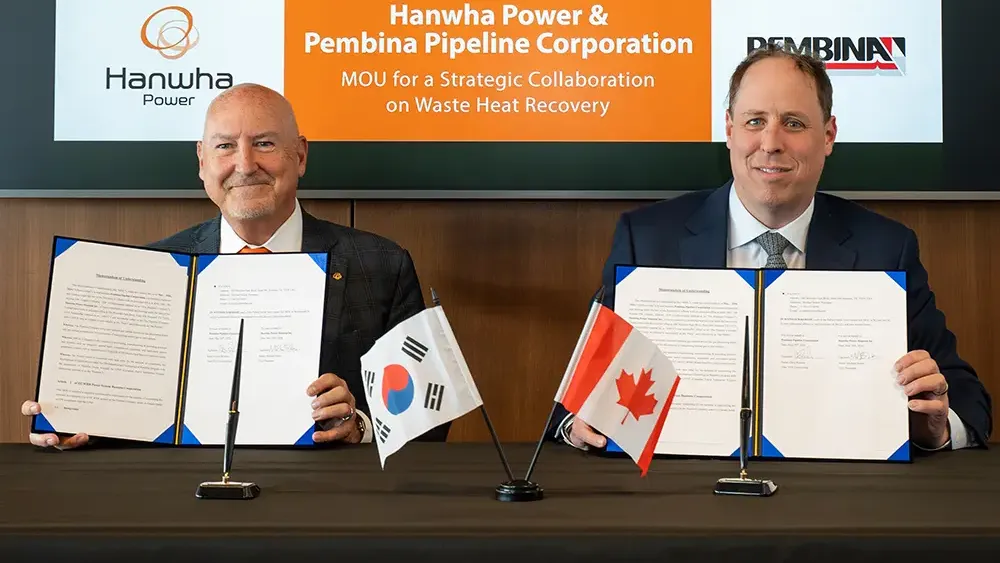
Hanwha Power and Pembina Pipeline Corporation have signed a non-binding memorandum of understanding to collaborate on a low-carbon power generation project.
The partnership will focus on developing waste heat recovery (WHR) power systems using supercritical carbon dioxide technology at Pembina’s compressor stations and gas infrastructure in North America.
Both companies will jointly evaluate pilot project sites and conduct technical and economic feasibility studies, whilst also exploring broader applications of low-carbon power generation in the midstream energy sector.
Hanwha’s WHR technology generates electricity by reusing industrial waste heat without additional fuel input. It uses supercritical carbon dioxide as a working fluid, enabling compact, water-free, and potentially unmanned operation, while reducing carbon emissions.
Pembina, based in Canada, operates pipelines, gas processing facilities, and export terminals. It said the collaboration could improve asset efficiency and support emissions reduction goals.
Hanwha Power said the project supports its expansion in Canada and North America, alongside ITB-linked cooperation tied to Hanwha Ocean’s Canadian Patrol Submarine Project.












 Read Here
 Advertise
 Sign Up