Renewables dominate Indonesia's future power plan
Electricity demand is expected to rise by 67%.
Indonesia’s latest 10-year electricity business plan signals a major shift in energy priorities, with 61% of 69.5 gigawatts of planned new capacity coming from new and renewable energy. The plan, released by the Ministry of Energy and Mineral Resources, forecasts a 67% rise in electricity demand—from 306 TWh in 2024 to 511 TWh by 2034.
“The decision was based on at least three reasons,” said Fabby Tumiwa, Executive Director of the Institute for Essential Services Reform. “To meet national development targets and priorities, to supply long-term electricity services, and to meet net zero emission by 2060 or sooner.”
PT PLN (Persero), the state-owned power utility responsible for delivering over 80% of Indonesia’s electricity, leads the implementation of the plan. Tumiwa noted that the plan is “dynamic” and reviewed every two to three years.
However, the inclusion of new coal capacity alongside renewables drew criticism. “The inclusion of new coal capacity in the same plan sends mixed signals,” said Dinita Setyawati, Senior Energy Analyst for Asia at Ember. “The ambition is there, but the question remains of how the government could build full momentum by prioritising renewables and also excluding coal in the new development plan.”
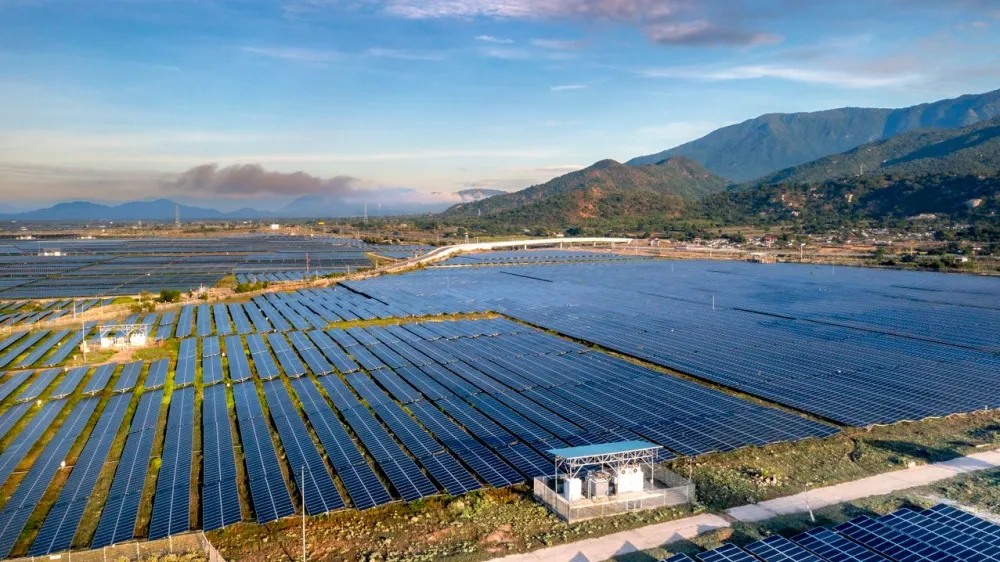
Solar energy is expected to contribute 17.1 GW, the largest share among renewable sources. But that ambition comes with structural challenges.
“To address land issues, prioritising underutilised or state-owned land and promoting floating solar and enabling co-locations with agriculture… can reduce land use conflicts,” said Setyawati. She added that streamlined digital permitting, clear agency timelines, and de-risking mechanisms are also necessary.
Tumiwa emphasised that the target is modest compared to the country’s potential. “This 17.1 gigawatt is actually very, very small compared to the technical potential, which could reach more than 20,000 gigawatts,” he said.
“These large-scale projects often carry higher risk and upfront costs… by bringing in technical expertise, financing capacity and risk mitigation tools, international stakeholders can help de-risk project development,” Setyawati said.
Tumiwa outlined five areas where international players can help: project development, financing, technology transfer, policy support, and capacity building. “We need a lot of finance to support this… about $180 billion in the next 10 years,” he said.















 Read Here
 Advertise
 Sign Up








Commentary
Why bigger digesters alone won't solve Asia's renewable energy challenge
Scaling for resilience: What Asia Pacific’s bioenergy markets can learn from each other