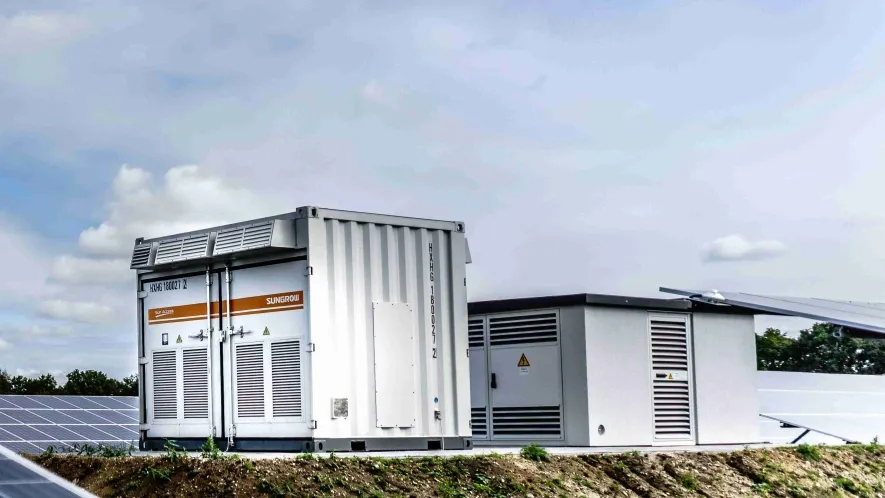
India’s merchant battery storage faces first regulatory test
Draft central and state rules restrict grid charging.
India’s merchant battery energy storage system (BESS) sector faces its first regulatory test as draft central and state rules restrict grid charging and tighten operational control, challenging the model that underpins most deployed capacity, a JMK Research report said.
Merchant systems account for about 80% of India’s 6.8 gigawatt-hours (GWh) of operational BESS capacity, with major projects including Adani’s 3,370 megawatt-hours (MWh) facility in Gujarat and ACME’s 2,031 MWh project in Rajasthan.
Developers have adopted the model as falling battery costs and widening day–night price spreads have enabled arbitrage in wholesale electricity markets.
A merchant BESS charges when prices are low and discharges when prices are high.
“This was visible in April 2026, when surplus solar drove Real-Time Market prices on the Indian Energy Exchange to near-zero levels, even as evening Day-Ahead Market prices approached the INR 10 per kilowatt-hour cap,” the report said.
The spread has supported battery arbitrage and solar shifting into peak demand hours.
Two draft frameworks now constrain that structure, with the 44th Consultation Meeting for Evolving Transmission Schemes in Western Region (CMETS-WR) at the central level and Rajasthan’s RVPN draft procedure at the state level.
The changes shift storage from standalone merchant assets to hybrid renewable-storage systems.
Developers estimate capital costs rise 60% to 80% depending on configuration, driven by additional renewable build requirements, land and approvals.
The rules also remove access to the cheapest grid charging periods and narrow arbitrage spreads. Dispatch discretion adds revenue uncertainty that lenders are likely to price into higher financing costs.
“India has crossed the 50% non-fossil installed power capacity mark in 2025, ahead of its 2030 target, and the National Electricity Plan 2023 estimates a BESS requirement of 47.24 gigawatts / 236.22 GWh by 2031–32,” the report said.
Industry participants have raised concerns that tighter constraints on merchant operation could slow investment and affect deployment timelines.
A revised approach under the 45th CMETS-WR meeting has introduced partial changes, but implementation across central and state authorities will determine the impact on financing and build-out.

















 Read Here
 Advertise
 Sign Up