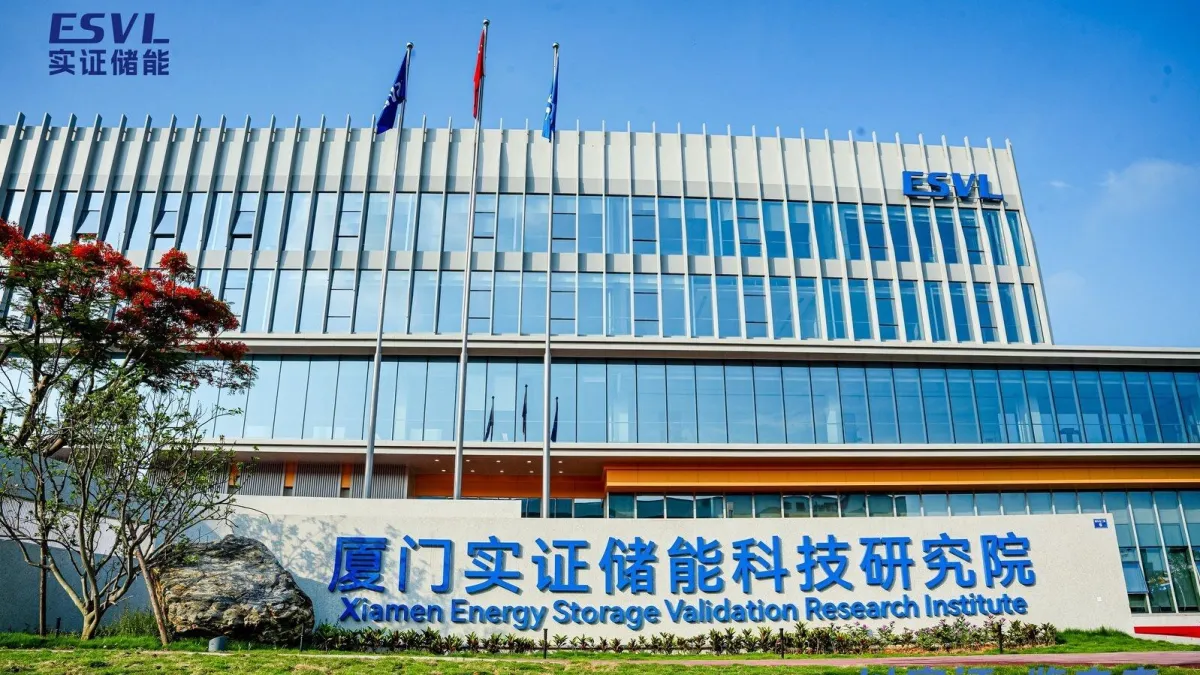
New CATL facility targets gaps in energy storage testing and validation
It is designed to test systems at station-level under real grid conditions.
China's CATL has officially begun operations at its Xiamen Energy Storage Validation Research Institute (ESVL), a large-scale testing and validation platform.
The facility spans 10 hectares and required an investment of about $440m (RMB3b). It is designed as a shared infrastructure platform for global energy storage companies.
The launch comes as the industry faces growing performance and deployment issues. Nearly 20% of large-scale energy storage stations worldwide are underperforming, and 46.5% experience grid-connection delays of more than two months, highlighting gaps in current testing methods.
ESVL shifts validation from component-level testing to full system and station-level verification under real operating conditions, focusing on safety, grid performance, and long-term reliability.
The Energy Storage Validation Research Institute (ESVL) includes five core laboratories designed to test energy storage systems under real-world conditions, starting with a Grid Integration Lab that uses a 35kV/100MVA simulator to evaluate large-scale systems, simulate complex multi-node grids, and assess grid-forming and coordination performance, alongside a High-Voltage Safety Lab that tests systems from 1kV to 500kV to identify failure mechanisms and improve fire and explosion prevention.
It also features a Thermal Safety Lab that conducts large-scale combustion and explosion testing using a 20MW calorimeter on multiple energy storage containers, and an Environmental Reliability Lab that evaluates system performance under extreme conditions ranging from -50°C to 100°C and high-altitude simulations up to 7,200 meters to ensure durability in harsh operating environments.
In addition, the institute includes an EMC Lab that tests full 40-foot energy storage containers under real charge and discharge conditions to detect electromagnetic interference risks and ensure stable communication and control performance before deployment.



















 Read Here
 Advertise
 Sign Up