Philippines pays more for power than most Southeast Asian peers
Imported fuel and grid costs continue to drive electricity bills higher.
Lea Mariño, 55, barely had time to complain about the heat before another shock arrived: her electricity bill.
When Manila Electric Co. (Meralco) raised residential rates in April, the compliance officer and mother of three had little choice but to absorb another household expense despite already rising living costs.
“The increase was far too big,” Mariño told Asian Power. “But we don't really have a choice. We'd rather pay than have our electricity cut off.”
For Joy Sevilla, a 59-year-old mom-and-pop store owner, the frustration was not limited to the amount due.
“It's unfair,” she said in mixed English and Filipino. “There are so many charges on the bill that don't seem like consumers should be paying, on top of our taxes.”
Their complaints reflect a broader problem. Filipino households pay some of Southeast Asia's highest electricity prices because the country relies heavily on imported fuel, operates one of the region's most complex power grids, and passes much of those costs directly to consumers.
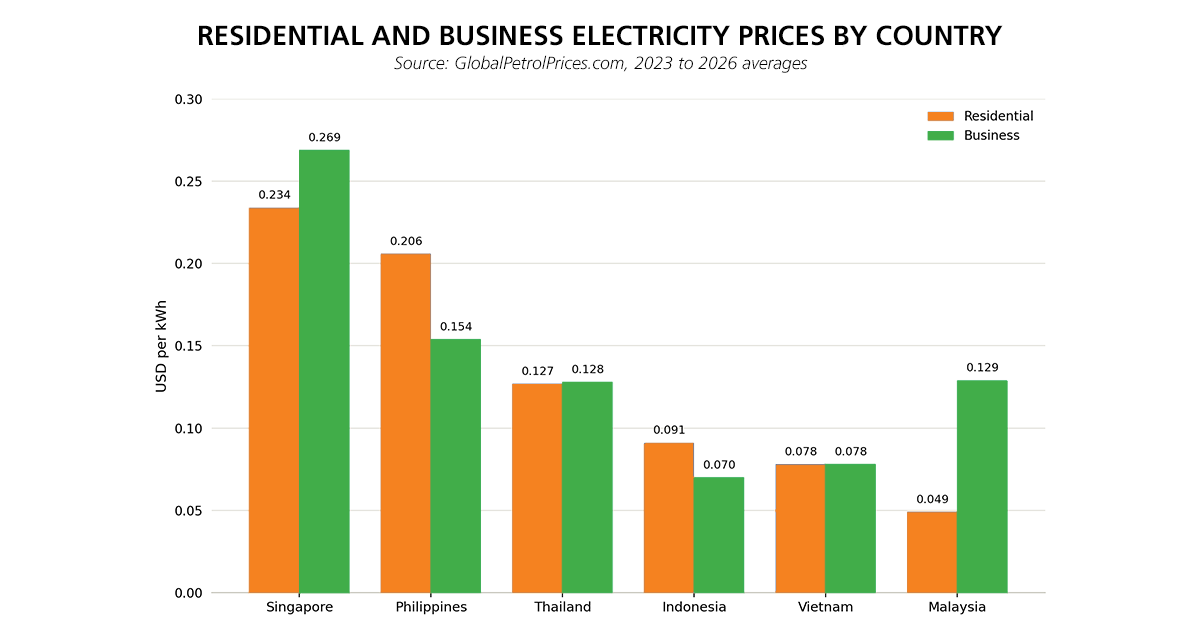
GlobalPetrolPrices data for the first quarter of 2026 placed Philippine residential electricity prices at about $0.21 per kilowatt-hour (kWh), second among six major Southeast Asian economies surveyed and behind only Singapore at $0.232 per kWh.
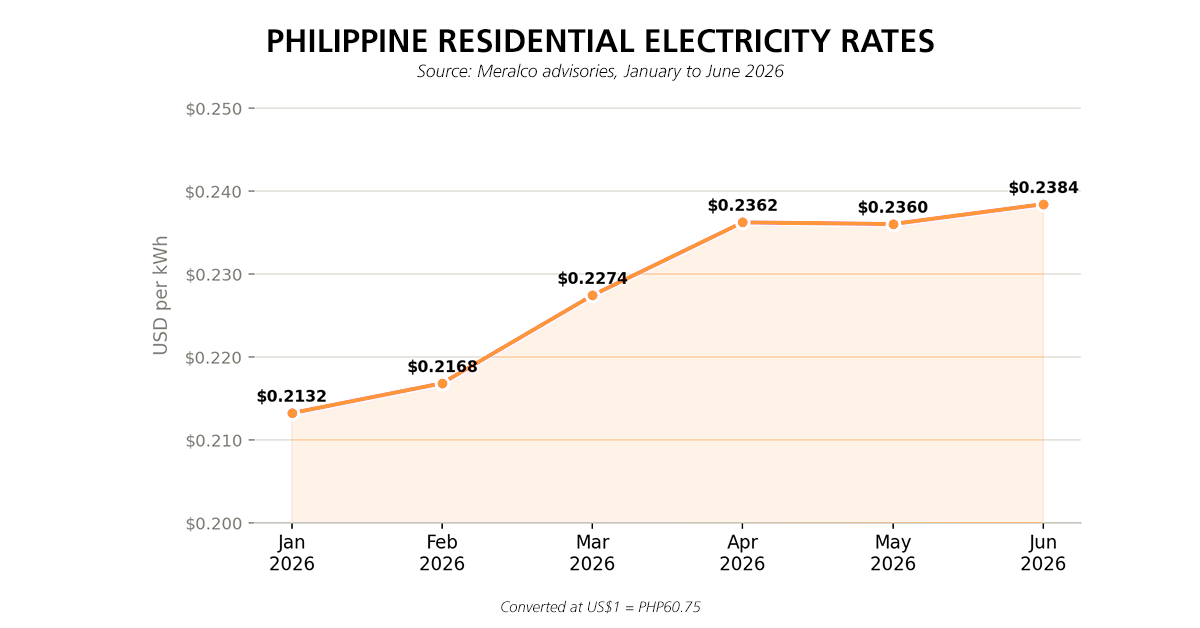
The increase became more apparent in April. Meralco, the country’s biggest private electric distribution utility serving more than 8.2 million customers in Metro Manila and nearby provinces, raised the residential rate by $0.0087 (PHP0.53) to $0.23 (PHP14.35) per kWh from the previous month. A household consuming 200 kWh paid about $1.75 (PHP107) more, with larger increases for homes using more electricity.
Although the rate eased slightly in May after an Energy Regulatory Commission (ERC) refund order, electricity remained expensive by regional standards.
Meralco raised rates again in June to $0.23 (PHP14.48) per kWh, the highest monthly residential rate on record.
A Philippine electricity bill combines generation, transmission, distribution, taxes, and other regulated charges. Some are controlled by regulators, whilst others rise or fall with fuel prices, exchange rates, and conditions across the national power system.
The framework dates back to the Electric Power Industry Reform Act of 2001, better known as EPIRA, which separated electricity generation, transmission, and distribution to encourage competition in power generation whilst keeping the grid and distribution networks regulated.
Imported fuel burden
Patrick Tan, head of wider Asia at Aurora Energy Research, said the Philippines remains one of the few fully liberalised electricity markets in Southeast Asia.
He said Malaysia, Thailand, and Indonesia benefit from bigger domestic fuel resources or regulated pricing systems that shield consumers from much of the volatility in international fuel markets. Philippine consumers absorb more of those costs through their monthly electricity bills.
"The Philippines does not have the luxury of those resources," Tan said via Zoom.
Gas plants once supplied by the Malampaya field increasingly run on imported liquefied natural gas (LNG), he said, tying that portion of the country's supply to global markets.
Unlike Malaysia and Indonesia, which produce much of their own fuel, the Philippines imports most of the coal and LNG used by its power plants. Those purchases are priced in dollars, leaving electricity costs exposed to swings in global energy markets and the peso-dollar exchange rate.
That exposure has become more pronounced as domestic gas production declines and imported LNG supplies a growing share of electricity demand.
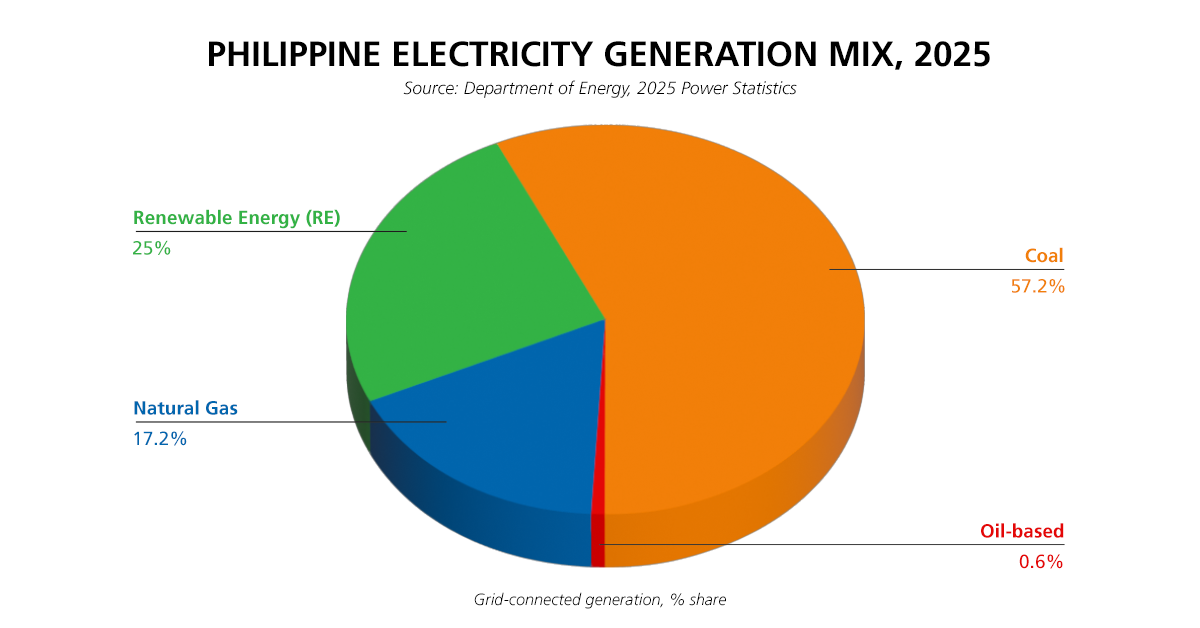
Department of Energy (DOE) data showed that coal accounted for 57.2% of the Philippines’ electric generation in 2025. Most of that coal was imported, making generation costs vulnerable whenever global coal prices or the peso move sharply.
The peso's depreciation to PHP60.748 against the dollar for the March supply month alone added about $0.0086 (PHP0.5257) per kWh to April's generation charge.
Comparisons with neighbouring countries often overlook those structural differences, Tan said.
Fuel, however, explains only part of the story.
The Philippines is an archipelago of more than 7,000 islands, making it impossible to build a single interconnected transmission network like those serving most mainland Southeast Asian countries.
Electricity must travel across separate island grids linked by submarine cables and high-voltage transmission lines, increasing both construction and maintenance costs.
The Asian Development Bank estimates the country needs about $10b in transmission investment to boost and expand the grid as electricity demand continues to grow.
Those costs also appear on consumers' monthly bills. Transmission charges rose sharply in March after National Grid Corporation of the Philippines (NGCP) increased spending to keep the grid stable, accounting for nearly half of that month's transmission charge, Meralco said in an advisory.
Higher fuel costs, a weaker peso, and a transmission network that is expensive to build and maintain have combined to keep Philippine electricity prices among the highest in the region.
May power squeeze
Those pressures became even more visible in May, when transmission failures and power shortages pushed wholesale electricity prices sharply higher.
Wholesale electricity prices climbed in May after the Luzon grid entered one of its most severe supply squeezes in recent years, exposing how quickly generation and transmission failures can filter through to consumers.
The pressure had been building before the power failures. Twenty-seven power plants in Luzon were offline or operating below capacity, some since 2019, whilst record temperatures pushed electricity demand to successive highs.
Within a week, the grid broke its all-time peak demand record twice, National Grid Corporation of the Philippines spokesperson Cynthia Alabanza told Asian Power in an interview.
The Visayas grid was also under a yellow alert on May 12, with power reserves below the transmission grid's contingency requirement, limiting the support it could provide to Luzon if supply tightened further.
The situation worsened on May 13 when the Ilijan–Dasmariñas and Ilijan–Tayabas 500-kilovolt transmission lines tripped, disconnecting more than 2,400 megawatts of generating capacity from the Luzon grid.
The power failures triggered manual load dropping that affected about 3.9 million customers across Metro Manila and parts of the main Luzon island. Several large power plants could no longer deliver electricity to the grid, forcing the system into a multi-day red alert.
Katrina A. Garcia-Amuyot, senior manager for metering, registration, and stakeholder services at the Independent Electricity Market Operator of the Philippines (IEMOP), said the loss of transmission capacity sharply reduced available supply during a period of heavy electricity use.
“The price determination process in WESM during that period functioned as designed,” she said in a video call, referring to the Wholesale Electricity Spot Market. Prices there climbed to about PHP10 to PHP11 per kWh during the affected trading intervals as the market relied on more expensive generating units to meet demand.
Garcia-Amuyot said the increase reflected tighter supply rather than a failure of the market itself. She said market safeguards, including the secondary price cap that limits extreme price spikes during severe supply shortages, were activated during parts of the alert period.
Despite the May spike, very high wholesale prices remain uncommon. IEMOP data showed the secondary price cap was triggered during less than 1% of all trading intervals in both 2025 and the first five months of 2026.
The May disruption showed how several pressures converged at the same time. High temperatures increased electricity demand, power plants that were shut down for maintenance or unexpected problems reduced available supply, and transmission failures prevented operating plants from delivering electricity when it was needed most.
Energy Undersecretary Mario Marasigan said electricity prices are affected by conditions across the power system rather than by a single factor.
“Electricity prices are influenced by multiple parts of the power system, including generation, transmission, and reserve requirements," he said via Zoom.
He added that delays in either power generation or transmission projects could increase costs because both must be completed on roughly the same schedule.
“If power plants are delayed while transmission projects are completed on time, there's a mismatch,” Marasigan said. “The same happens if transmission projects are delayed while power plants are ready. Either way, it will cost us.”
The DOE later issued two circulars to reduce those bottlenecks. One lets power developers build transmission facilities needed to connect their projects when NGCP can’t complete them on time.
The other authorizes the National Transmission Corp. to step in when NGCP falls behind commitments under its transmission development plan.
Those measures aim to shorten the time needed to connect power plants to the grid, reducing the risk that completed generating facilities remain idle whilst waiting for transmission infrastructure.
Questions over the May power failures, however, extended beyond project delays.
An Energy department inspection team reported that NGCP operations and maintenance personnel had identified corrosion on insulators at Tower 70 of the Dasmariñas–Ilijan transmission line as early as February 2026 and recommended repairs under the grid maintenance program.
“Until the outage happened, the repair and maintenance did not occur,” Marasigan said.
For the Ilijan–Tayabas line, the regulator has not ruled out metal fatigue because the line carried the full output of the Batangas gas plants after the first transmission corridor failed.
The May power failures also renewed scrutiny of how the country's transmission system is managed and whether enough has been invested to keep pace with rising electricity demand.
Alabanza said the initial trip of the Dasmariñas–Ilijan transmission line did not meet the regulatory threshold requiring a significant incident report.
"Was there a reporting failure? No,” she said. “Everything was within the bounds of what the regulations allow.”
She also pointed to the way power plants are distributed across the country. Most of Luzon's generating capacity is concentrated in a handful of locations, whilst the National Capital Region has almost no power generation of its own.
Cebu has limited generating capacity and Samar has none despite sitting along a major transmission corridor.
“When something goes wrong in a concentrated cluster, everything in that cluster goes down together,” Alabanza said.
The search for lower power costs
The ERC ordered the delayed collection of about $0.0096 (PHP0.5927) per kWh in generation-related charges to reduce the immediate effect on consumers.
The measure delayed the collection of part of those costs instead of removing them. Consumers paid less in the short term, but the expenses remained part of future bills.
Electricity prices also drew congressional scrutiny. The Senate summoned officials from the ERC and Meralco to explain April's rate increase, with lawmakers proposing to stagger generation charge increases, review subsidy-related charges, amend the Electric Power Industry Reform Act, and examine how refunds are returned to consumers.
The House of Representatives also launched an inquiry into the May 13 transmission failures, questioning whether NGCP violated the Philippine Grid Code by allegedly failing to promptly report the Dasmariñas–Ilijan line trip and submit a complete root-cause analysis.
Separate Senate action also sought an inquiry into repeated red and yellow alerts across the Luzon and Visayas grids.
The investigations reflect a broader debate over the electricity market more than two decades after EPIRA reshaped the industry.
Generation companies compete to sell electricity, but distribution utilities remain responsible for buying power through long-term supply contracts and recovering approved costs from consumers.
That structure has prompted recurring questions over whether companies with interests in both generation and distribution exercise too much influence over electricity procurement.
"You are complaining about the tariff in pesos, but do you know how much all these companies are making?" Tan said. "For a company at the scale of Meralco, a 10% net profit margin is a lot of money."
Still, Tan said policymakers face a difficult balance. He noted that big distribution utilities could negotiate lower prices because they buy electricity in bulk, but concentration could also reduce competition if procurement is not closely monitored.
He said the challenge is preserving competition whilst giving utilities enough purchasing scale to secure reliable electricity supplies through long-term contracts subject to regulatory review.
The debate over electricity prices extends beyond one month's bill or a single transmission failure.
The Philippines remains exposed to forces that regulators cannot fully control, including imported fuel prices and movements in the peso. Those pressures become more pronounced when demand rises sharply or major transmission assets fail.
Meralco's June adjustment reflected those conditions. It attributed the increase mainly to higher generation charges following stronger Wholesale Electricity Spot Market prices, higher fuel costs, and the peso's depreciation.
Generation charges climbed to $0.1451 (PHP9.0704) per kWh as tighter supply forced the system to draw more electricity from the spot market.
The Energy department expects thousands of megawatts of additional capacity to enter the system over the next several years, but those power plants will provide little relief if transmission projects are delayed.
Transmission lines and substations determine whether electricity can reach homes and businesses after it is generated. Delays to either side of the system increase costs because completed assets cannot operate at full value until the rest of the network catches up.
That makes transmission investment as important as building power plants.
For consumers such as Mariño and Sevilla, however, those long-term projects offer little comfort when the monthly bill arrives.
Mariño said households have little room to reduce electricity use during the hottest months of the year because fans, refrigerators, and air-conditioners become necessities rather than luxuries.
Sevilla said small businesses face the same dilemma. Higher electricity bills reduce already thin earnings, yet turning off refrigerators or lights means losing customers and sales.
Their experiences illustrate the challenge facing the Philippine power sector. Electricity prices reflect far more than the amount of power consumed. They also capture the cost of imported fuel, the value of the peso, the condition of transmission lines, power plant availability, and the policies governing one of Asia's most liberalised electricity markets.
Until generation and transmission expand fast enough to keep pace with demand, Filipino households are likely to remain among the region's highest-paying electricity consumers.
-- with reports from Alec Maquiling and Sam Bernardo

















 Read Here
 Advertise
 Sign Up