Staff Reporter
Chinese scientists develop revolutionary “smart window”
Window both reflects heat and generates electricity.
Malaysia reports surge in renewable energy projects
Ignited by implementation of Feed-in Tariff in 2011.
Mitsui pushes ahead with wave power technology
Partners with Ocean Power Technologies Inc.
Indonesia begins moves to amend Geothermal Law
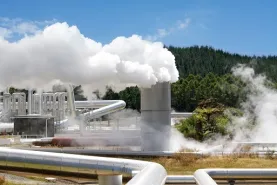
Revision to optimize the utilization of geothermal energy. The Ministry of Energy and Mineral Resources has filed a draft bill at the Indonesian parliament to revise Law No. 27 of 2003 on Geothermal Energy. Commission VII at the House of Representatives has formed a Special Committee to further discuss the draft bill. Jero Wacik, Minister of Energy and Mineral Resources, said that as a renewable energy source, geothermal energy has great potential to contribute to electricity distribution in Indonesia. Indonesia has up to 40% of the world’s potential geothermal energy resources capable of producing 30,000 MW of electricity annually. Despite its great potential, the development of geothermal energy is currently being held back by cross-ministry regulations. This is a consequence of geothermal energy production being considered a mining activity. This has caused problems for exploiting geothermal hotspots in forest areas that requires permits from the Ministry of Forestry and Ministry of Environmental Affairs.
India allows Chinese to set-up PESCs
Demand for Chinese power gear rising in India. India has allowed power equipment makers from China to set up power equipment service centers (PESCs) in India. India has become a strategic market for Chinese power equipment manufacturers.
Korea’s industrial electricity sales rise 2.9% in September
This despite a drop in exports.
South Koreans to build Philippine solar power plant
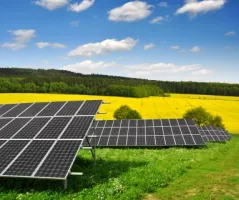
It will be the largest solar power plant in the Philippines.
JinkoSolar to build 120 MW rooftop array in Zhenjiang
Project will cover 1.2m sq m.
Japan to develop new nuclear waste disposal technology
Involves extracting radioactive substances from spent nuclear fuel.
Japan considers one operator to run all nuclear plants
Option will also keep Tepco alive to pay its debts. Japan’s government is discussing this radical overhaul of its nuclear power sector to rebuild an industry wracked by the aftermath of the 2011 Fukushima nuclear disaster and strong public opposition to nuclear energy. The proposed sole operator that will handle all 50 reactors. will be owned by Japan’s nine regional utilities and two wholesalers (Japan Atomic Power Company and Electric Power Development Company). The government and local reactor makers will provide financial and technical support, said Taku Yamamoto, chairman of the Liberal Democratic Party’s energy committee. Part of the profit from sales of the new company’s electricity will be used for the cleanup of Tokyo Electric Power Company’s (Tepco) destroyed Fukushima nuclear plant and victim compensation, which combined may cost over US$112 billion. The plan will keep Tepco alive to shoulder Fukushima costs and avert any blackouts in Tokyo, which will host the 2020 Olympic Games. Yamamoto said the plan is based on Tepco’s profits covering Fukushima costs without taxpayers’ money and to increase the government’s role in the nuclear industry. He said Tepco has to go on working hard for the Fukushima disaster until it dies.
Japan will retain nuclear power
Will maintain its current share of nuclear energy. Japan's government will maintain nuclear energy’s share in its energy mix with the proviso that safety is assured. Media sources said the Japanese government will revise its current energy policy, devised in 2010 by the end of 2013. The new policy will contain revisions and reflections upon the Fukushima-Daiichi nuclear disaster of March 2011. Policy revision work will begin in November. A subcommittee called the Advisory Committee for Natural Resources and Energy will be in charge of revisions. Japan current energy policy calls nuclear power a key source of electric power. Japan also has a policy to increase the proportion of its power generation that produces no greenhouse gases or carbon dioxide to 70% non-emitting sources by 2030. Prime Minister Shinzo Abe said his government intends to cut Japan's reliance upon nuclear energy wherever possible.
India test runs controversial Kudankulam nuclear reactor
Start-up delayed for six years. Nuclear Power Corporation of India Ltd., the nation’s sole atomic energy producer, has test-started the first unit of the Kudankulam nuclear power plant in the southern state of Tamil Nadu. The reactor was operated for two hours at a capacity of 175 megawatts. Station director Hari Narayan Sahu said the unit should run at half its capacity by Oct. 26 and reach its maximum output of 1,000 MW in six weeks while the second reactor should start in a year. Public rallies against Kudankulam are directed against the first two reactors, both of which are not covered by any liability law. The Kudankulam reactor is the result of a bilateral agreement between India and Russia signed before the Civil Liability for Nuclear Damages Act became a law in 2010. The law makes atomic plant suppliers and builders liable in the event of nuclear accidents.
India’s renewable energy sector by the numbers
India’s total renewable energy potential is 150 GW. Despite this, India’s entire renewable energy sector contributes only 12% of India’s total power. About 65% of power from renewable energy sources comes from wind energy. Biomass accounts for 14%; small hydropower projects contribute 13% and solar energy 5%. Other sources contribute about 3%. The government intends to add 10 GW of solar energy by 2017 and 20 GW by 2022. India generates 1.8 GW of electricity from solar energy. India’s total installed power generation capacity stands at 223 GW, far less than the requirement. Demand for power is estimated to increase by 16 GW a year until 2020. The government plans to increase renewable capacity by 72 GW in the thermal sector; 11 GW in the hydro sector and 5 GW in the nuclear sector. Renewable energy sources contribute 29 GW of electricity. India expects to double this capacity to 55 GW by 2017. Solar energy generation alone will increase to 20 GW during this period under the Jawaharlal Nehru National Solar mission.
Here's a roundup of the 22nd World Energy Congress held in Daegu, Korea
The energy's future looks bright for Asia.
BHP Billiton abandons Indian energy projects
Cites delays in carrying out exploration.
Japan installs 1.82 GW of solar PV capacity
Boosted by commercial project installations.
Energy efficiency is the world’s “first fuel”
Vital to cutting carbon emissions and promoting energy security.
Commentary
Supply chain efficiency, skilled manpower are key for India’s renewable energy